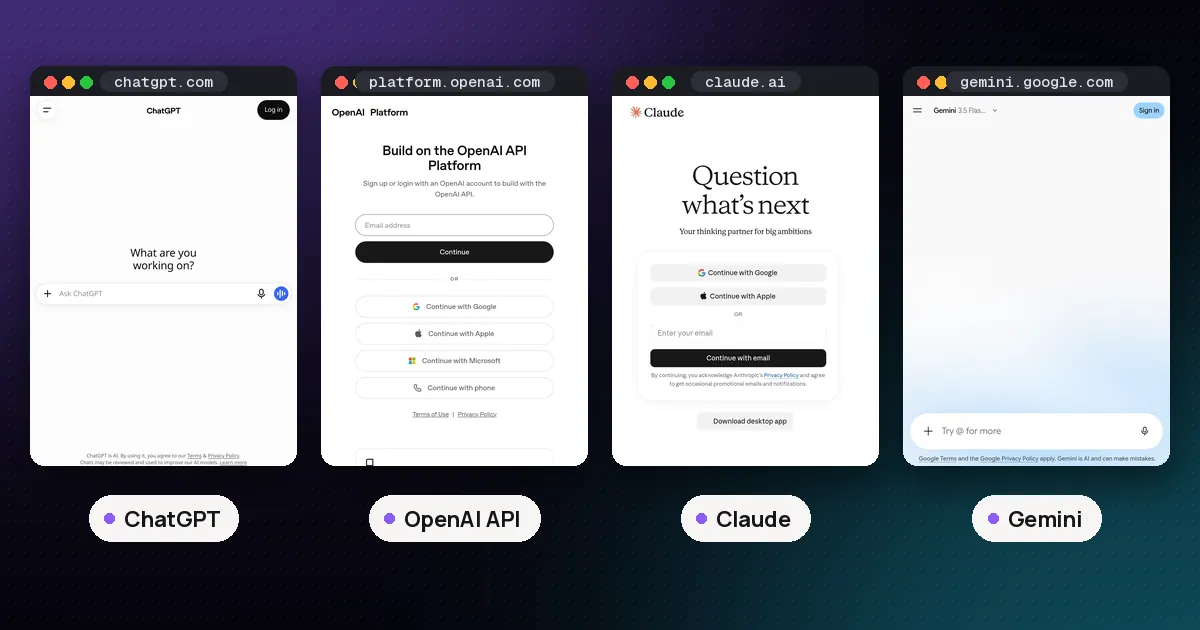
ChatGPT vs LLM is not a choice between two rival products. A large language model (LLM) is the underlying technology: a model trained on huge amounts of text to predict the next token. ChatGPT is OpenAI's app built on top of LLMs, adding a chat window, memory, web search, file tools, safety layers and paid plans. So ChatGPT uses LLMs, but an LLM on its own is not ChatGPT.
That difference matters in practice. It explains why ChatGPT can search the web while a raw model cannot, why your subscription does not cover developer API usage, and why "which LLM does ChatGPT use?" has more than one answer in October 2026. This guide covers each part, then helps you decide which one you actually need.
ChatGPT vs LLM at a glance
| Item | LLM | ChatGPT |
|---|---|---|
| What it is | A type of AI model | A consumer and business app from OpenAI |
| Made by | Many labs (OpenAI, Anthropic, Google, xAI and others) | OpenAI only |
| What you interact with | Text in, text out, usually through code or an API | A chat interface on web, desktop, mobile and messaging apps |
| Memory, search, files | Not built in; a developer must add them | Built in, with limits by plan |
| How you pay | Per token through an API, or free if you run open weights yourself | Free plan or a monthly subscription |
| Examples | GPT-6 Sol, GPT-6 Luna, GPT-6 Astra, Claude and Gemini models | ChatGPT Chat, ChatGPT Work, the ChatGPT desktop app |
In plain words: the LLM is the engine, and ChatGPT is the whole car built around that engine, including the seats, the dashboard and the brakes.
What is an LLM?
Google's Machine Learning Crash Course describes a language model as a system that estimates the probability of a token, or a sequence of tokens, appearing within a longer sequence. A token can be a whole word, part of a word or a single character. Google adds that for English, one token is roughly four characters, or about three quarters of a word. A large language model does the same job at enormous scale: Google's LLM module explains that LLMs beat older approaches because they contain far more parameters and take in far more context.
Stanford HAI gives a similar definition: an AI system trained on massive amounts of text to understand and generate humanlike language, using neural networks with billions of parameters to answer questions, translate, write code and more.
Two points from those sources are worth remembering:
- An LLM predicts. It produces the most likely continuation of the text it is given. It has no built in idea of who you are, what day it is or what is on a website right now unless that information is put into its input.
- An LLM makes mistakes. Google lists hallucination, meaning predictions that contain errors, as a core problem of using LLMs, along with heavy computing costs and bias.
Most current models also handle images and audio, but the core idea is the same. For how this technology relates to the bigger goal of human level AI, see our guide to AGI vs LLM.
Is ChatGPT an LLM?
Not exactly. ChatGPT started life as a model name and became a product name.
When OpenAI launched ChatGPT on November 30, 2022, its announcement said "We've trained a model called ChatGPT which interacts in a conversational way." OpenAI explained that ChatGPT was fine tuned from a model in the GPT-3.5 series and trained with reinforcement learning from human feedback (RLHF), the same method it had used for InstructGPT. That method is described in OpenAI's research paper Training language models to follow instructions with human feedback: people write and rank example answers, and the model is tuned toward the answers they prefer.
So in 2022, ChatGPT really was a single tuned LLM with a simple chat page. OpenAI's own post now carries a note that ChatGPT "has evolved substantially since then," and that is an understatement. Today ChatGPT is an app that sends your messages to whichever OpenAI model fits your plan and settings, wraps the answer in tools, and keeps track of your history. If you are picking a plan for a company, see ChatGPT vs Enterprise.
The short answer: ChatGPT is powered by LLMs, but ChatGPT itself is software built around them.
What LLM does ChatGPT use in October 2026?
Several, and it depends on your plan and the mode you pick. According to OpenAI's GPT-6 announcement of October 7, 2026, and the matching entry in the ChatGPT release notes:
| Where in ChatGPT | Model behind it |
|---|---|
| GPT-6 in the Chat tab, Plus, Pro, Business and Enterprise | GPT-6 Sol |
| GPT-6 in the Chat tab, Free and Go | GPT-6 Luna |
| The Pro reasoning option | GPT-6 Astra |
| ChatGPT Work and Codex | Separate model versions, chosen in the model list |
Said simply: paying users chat with GPT-6 Sol, free and Go users get the lighter GPT-6 Luna, and the Pro reasoning option runs on Astra, OpenAI's most capable model. OpenAI's help center adds that older models such as GPT-5.6 Sol stay selectable, so one ChatGPT account can reach several different LLMs in a single day. The Verge's coverage of the launch confirms the same split between Sol for higher tiers and Luna for free and Go users.
This is the clearest proof that ChatGPT and "the LLM" are different things: the product stayed the same while the models underneath it changed. For a full comparison of those models, read GPT-6 Sol vs Astra vs Luna.
What ChatGPT adds on top of the LLM
A bare model answers one prompt at a time. Everything else you see in ChatGPT is product work layered around it. Based on OpenAI's pricing page and release notes, that includes:
- Memory and history. ChatGPT can remember details across chats and reference past conversations, with limits by plan. You can view, edit or turn memory off.
- Web search and a browser. The model can look things up instead of relying only on what it learned in training.
- Files, images and voice. Uploads, image creation, data analysis and voice conversations.
- Plugins and connected apps. Links to services such as Gmail and Google Drive so the assistant can work with your own information.
- Agents. ChatGPT Work handles longer tasks such as research and finished documents, and asks you to approve important actions.
- Interface choices. Since October 2026, GPT-6 in the Chat tab can answer with charts, buttons and small interactive tools, a feature OpenAI calls Intelligent UI.
- Safety and privacy controls. Content safeguards, temporary chats, training opt outs and an optional Lockdown Mode that limits web access to reduce prompt injection risk.
None of these come with an LLM by default. If you used GPT-6 Sol directly through the API, you or your developer would have to build each one.
Pros and cons of using ChatGPT
Pros: nothing to set up, a free plan, a single place for chat, search, files and agents, regular model upgrades without any work on your part.
Cons: you get OpenAI models only, the model can change under you, usage limits depend on your plan, and your conversations sit on OpenAI's servers under its data settings. Our guide on how to use AI chatbots safely explains the privacy switches.
ChatGPT vs the OpenAI API
The most common practical mix up is between a ChatGPT subscription and API access to the same models. They are separate products. OpenAI's help article on managing billing for ChatGPT and the API platform says the two have separate billing systems, and that API usage is billed separately from your ChatGPT subscription. Another help page confirms API usage is charged by the number of tokens used, and the ChatGPT Business FAQ says a Business subscription does not include API usage.
| Item | ChatGPT | OpenAI API |
|---|---|---|
| Who it is for | People chatting and working in an app | Developers building their own apps |
| Billing | Free or monthly plan | Pay per token, separate account billing |
| Tools | Built in (memory, search, files, agents) | You build or switch on what you need |
| Model choice | Set by plan and picker | Explicit model ID in each request |
If you want to wire a model into your own product, start with our explainer on what an LLM API key is.
Pros and cons of using an LLM directly
Pros: full control over prompts and settings, pay only for what you use, freedom to switch between labs, and the option to build exactly the tool you need.
Cons: you need code or a developer, there is no memory or search unless you add it, costs can climb with heavy use, and safety and privacy design become your job.
ChatGPT vs other LLM products
ChatGPT is one of several flagship assistants built on frontier LLMs. Claude runs on Anthropic's models, Gemini on Google's, and Grok on xAI's. Each wraps its own LLMs in its own app, with different plans, tools and privacy rules. So when someone asks "ChatGPT or an LLM?", they often really mean "ChatGPT or another assistant?" Our ChatGPT vs Claude vs Gemini vs Grok comparison answers that question.
ChatGPT vs a local LLM
Some people compare ChatGPT with running an open weight model on their own computer. The tradeoff follows from everything above. A local model keeps your prompts on your machine and costs nothing per message once it runs, but you supply the hardware and setup, and you get only what you install: no hosted memory, search or agents unless you add them. ChatGPT gives you OpenAI's frontier models and the full toolset with no setup, in exchange for a subscription or free plan limits and cloud processing. Installing and tuning local models is outside what we cover here.
Which do you need?
- You want to ask questions, write, research or get tasks done: use ChatGPT or another assistant. You do not need to think about the LLM at all.
- You want the same model inside your own app or workflow: use an LLM through an API, and budget per token.
- You care most about keeping data on your own hardware: look at local open weight models and accept the setup work.
- You are comparing assistants: remember each one is a product wrapper around a lab's LLMs, so compare plans, tools and privacy as well as the model.
FAQ
Is ChatGPT an LLM?
ChatGPT is an app powered by large language models, not a single LLM. It launched in 2022 as one tuned GPT-3.5 model, but today it routes your messages to different OpenAI models, such as GPT-6 Sol, GPT-6 Luna and GPT-6 Astra, depending on your plan and settings.
What is the difference between an AI chatbot and an LLM?
An LLM is the model that predicts and generates text. An AI chatbot is an application that puts a conversation interface, and usually memory, search and safety rules, around one or more LLMs. ChatGPT, Claude and Gemini are chatbots built on LLMs.
Which LLM does free ChatGPT use?
OpenAI's October 7, 2026 announcement says GPT-6 in the Chat tab runs on GPT-6 Luna for Free and Go users from October 8, while paid plans use GPT-6 Sol and the Pro reasoning option uses GPT-6 Astra. OpenAI's model help page still names GPT-5.6 Luna as the Free and Go default for Instant, so what you see can vary while the rollout continues.
Does a ChatGPT subscription include the OpenAI API?
No. OpenAI says ChatGPT and the API platform have separate billing systems, and API usage is charged per token on its own account, even if you pay for ChatGPT Plus or Business.
Is ChatGPT better than other LLMs?
That question mixes two levels. ChatGPT is a product, so compare it with other products such as Claude, Gemini or Grok. The models behind it, such as GPT-6 Astra, can be compared with other labs' models, but the right pick depends on your task, budget and privacy needs.